Fahaka pufferfish tooth trimming time again today!

Well it’s time to trim Ollie’s teeth again. Ollie is now about 14 inches and he has a major overbite, so his teeth do not grind down cleanly when he eats. Yes, he needs regular dentist appointments!

As described in this blog, we have trimmed the teeth twice before, with the expert help of Cameron “the fish guy” Cunningham, who administers the anesthesia- MS222.

About Us

We have done the trimming previously in summer 2019 and then again in summer 2020, but that time I did not get the teeth as short as I wanted before he started to move his fins a little twitch and we needed to stop. So now it is time again- mid February 2021.

Preparing for the big event today, I wanted to remind anyone doing this that the dosage for powdered MS222 is one half level teaspoon in a bucket of 2.5 gallons of warm tank water. We use a plugged-in dremel tool with a diamond blade cutting wheel, and a non-serrated butter knife behind the teeth. You will need several buckets that hold several gallons of tank water and are big enough for the fish. Also a soaked clean microfiber rag to hold the fish, and rubber gloves for the one holding him, so that they don’t absorb the MS222.

There’s a video of our last trimming at @olliethepufferfish for anyone on Instagram. 🙂

And for a Facebook link: https://www.facebook.com/100007425274462/posts/2684917348432415/?extid=0&d=n

Please wish us luck! 🙂
One year later- will trim Ollie’s teeth again!

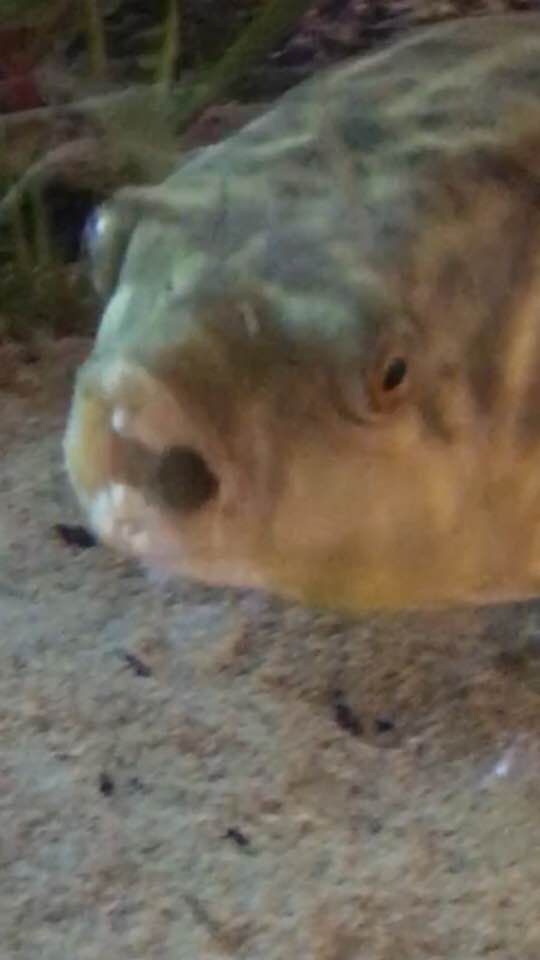
It’s just over a year later and we need to trim Ollie’s teeth again. We have realized that Ollie has an overbite, which is why his teeth don’t grind down properly in spite of his very crunchy (and expensive!) diet. he gets crabs at $2.99 USD each every two days, crayfish, clams, shell-on shrimp, mussels, live marmorkrebs- self-cloning crayfish, and MANY live snails, but for his overbite it isn’t quite enough. Videos of him living quite happily in his 300 gallon tank, in spite of this tooth situation, can be found at our instagram account @Olliethepufferfish. He has two slightly smaller siblings, Paulie and Wally (who are in separate tanks of course) who each have zero problems with their teeth- same diet.

Last time we did the tooth trimming, May 2019, there was a lot of action very fast once Ollie was caught and anesthetized, and we didn’t manage to get video- but this time we will. Cameron “the fish guy” is booked to come on Saturday, and our teen will put her iphone to good use recording the event.

Last time, after some scary moments where I was concerned about buzzing into his lips or tongue if I overshot, we realized that the key trick is to hold a (non-serrated) butter knife behind Ollie’s to teeth to act as a barrier for the dremel tool. Important! we already have this, and a new diamond-tip thinnest possible blade on the dremel tool. Buckets are ready and waiting. Cameron will bring the anesthesia.

Good luck to all of us! More to come.

After the tooth trimming last time- Ollie could eat snails again right after waking up and re-orienting himself in his tank! It was overall not as scary an experience as we had feared.

Trimming the teeth of a large fahaka pufferfish- the anesthesia

We chose to use MS222 because I had read that the alternative- clove oil – might cause progressive damage if used many times. Ollie is only 2 1/2 years old and I hope he or she lives many many more years. Likely will need to do this again.

Sadly, I could not purchase the MS222 anywhere online, to be shipped to California at least.

We were extremly fortunate to find Cameron “The Fish Guy” Cunningham – http://sacramentofishguy.com/ who helped us through the process and was able to obtain the anesthesia for his service. THANK YOU Cameron!

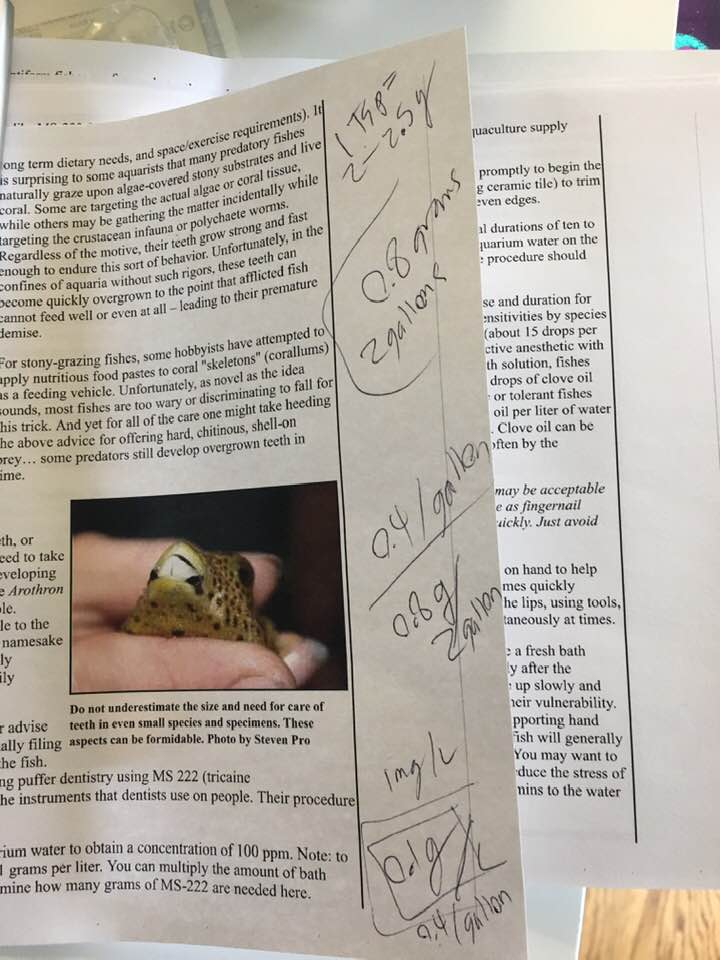
Then came the math. We needed 100ppm for the scale-less pufferfish- they need a lower dosage than other fish, but the sheet that came with the anesthesia was in tablespoons per salmon pond or something like that. After all of the calculations, it turned out to be 1/2 level teaspoon per 2.5 gallons of warm tank water.

puffer anesthesia math

This reference was TOTALLY our bible! you can see that I was scribbeling math and liter conversions all over it. Thank you to this post for the formulas!

Fish Dentistry:
Tooth Wear and Care in Predatory Fishes

by Kelly Jedlicki and Anthony Calfo

http://www.wetwebmedia.com/ca/volume_2/cav2i1/puffer_dentistry/puffer2.htm?fbclid=IwAR3EEAJFt8GFkqKoRG5xg4cpL4xA1LGLEkbi4p21XOCKoAPWd1Lx-oBV1Zo

Trimming Ollie’s teeth- why this blog?

Ollie in his 300 gallon tank

This site will have information for trimming the teeth of a large Fahaka Pufferfish- Ollie. He (or she?) is nearly a foot long and has had a very crunchy diet his entire life, but the teeth just kept growing. Ollie has two siblings who are smaller (in separate tanks of course) and their teeth are fine so far, on the same diet. Ollie just grew very large, very fast, including the teeth! 

Signs of trouble: Ollie started having trouble grabbing  red claw crabs as his teeth were getting a bit more “buck-toothed” in appearance. Then he stopped eating snails, and I knew it was time to face my worst fishkeeping fear- trimming those teeth using a dremel saw blade! Yikes! We could not find too much online about doing this for the very large puffs, although there are some excellent posts about the smaller puffs, and we did find one about trimming the teeth of “Fat Elvis” which was very useful. SO, having successfully trimmed Ollie’s teeth I decided to set up this blog to help others who might be also wondering about the process.

What Ollie looked like before the tooth trim. With this much overbite he could not open his mouth enough to grab crabs in the center, or larger snails.
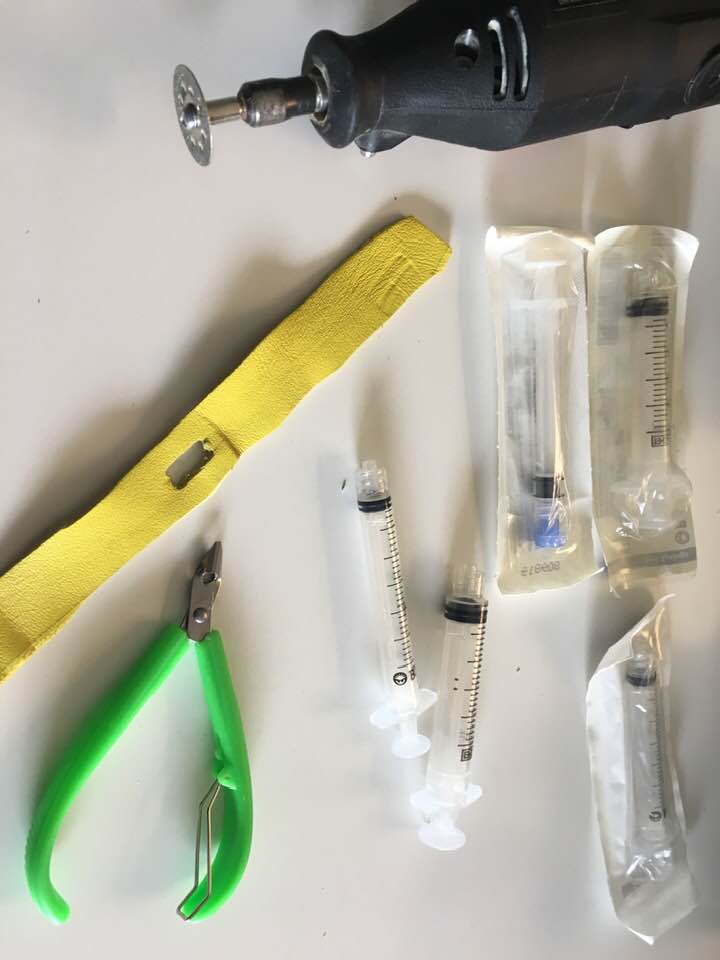
Puffer dentistry tools

SO, we assembled the tools – it is very important to get the extremely slim diamond-tipped cutting wheel for the dremel tool. Apparently there is a wheel that falls apart and that would be bad. We chose a plug-in dremel; although water is involved it does not come in contact with the tool, as the puffer’s head will be temporarily lifted out of the water.

We had seen others using syringes to put behidn the puffers teeth, so got several sizes ready. In the end, his teeth were pretty tightly together and these did not work. Our friend Karen, who was assisting with the procedure -thank goodness- suggested a butter knife (non-serrated), and that worked much better and also gave something to drill against without fearing that I would cut into the poor puffer’s tongue!

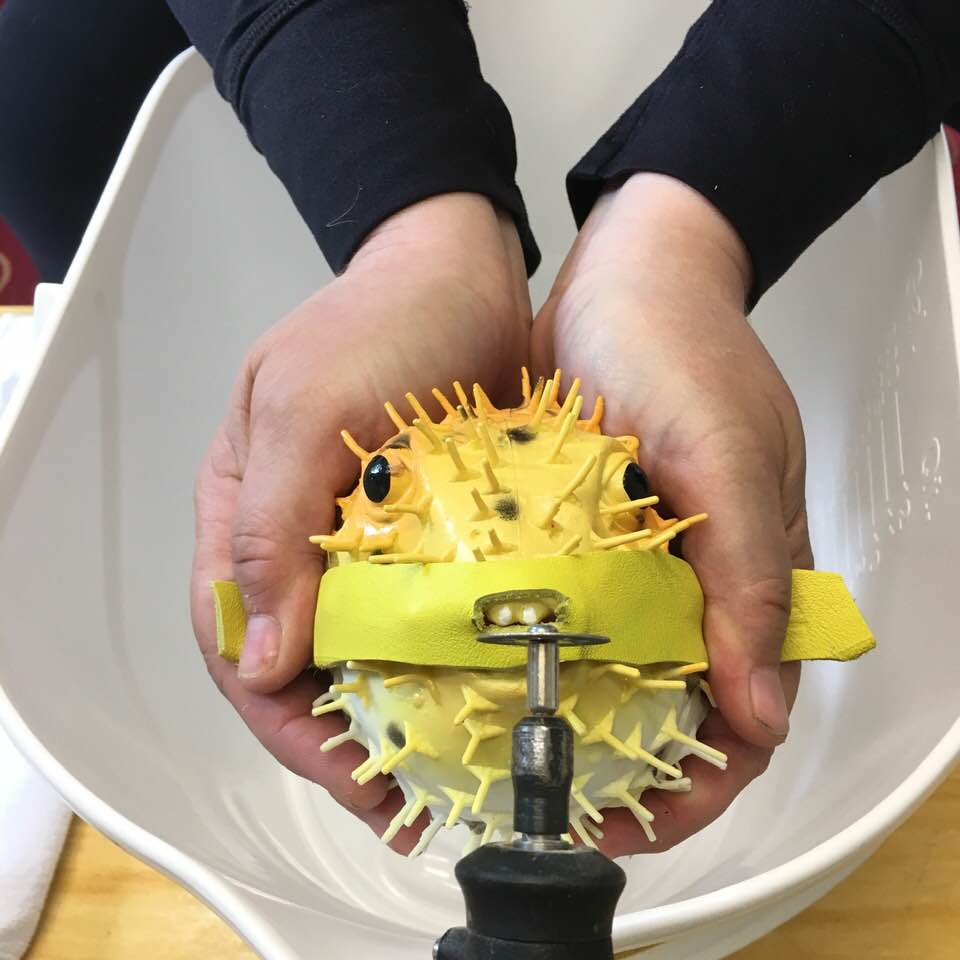
Karen had also made some cool leather straps that we thought could shield the lips, with the two top teeth sticking through them. That worked kind of, but the butter knife was definitely best!

haha- rubber pufferfish modeling the leather “gum protector” for practice before the procedure